



The Master Work is a Sunday letter for founders who have always known: the wider you draw from life, the deeper you can build. The muse of inspiration—and the source of wisdom—comes from the menageries of Life. The songs, the stories, the essays, the experiences, the conversations, the contemplation—all of it feeds the mission. Everything you’re reading, hearing, noticing, and living belongs here, in The Master Work.
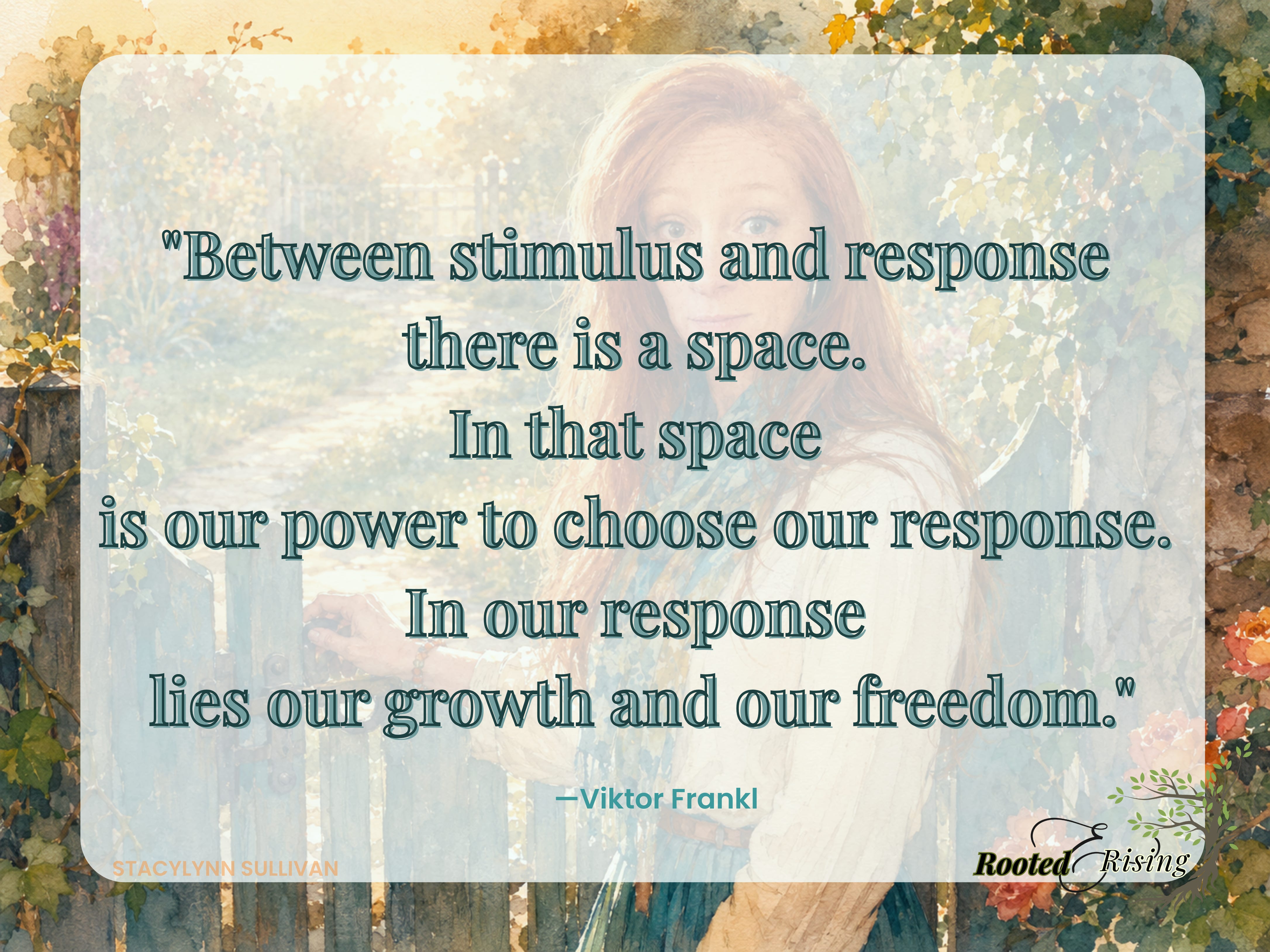
“Between stimulus and response there is a space. In that space is our power to choose our response. In our response lies our growth and our freedom.”
—Viktor Frankl
Welcome back to The Master Work!
This week, the thread found me in the gap between who I know I am meant to be and who I was actually being for about the larger part of this past week. This month, I’d been deliberately building a habit meant to shape me into someone steadier, more myself, and more recognizable in the mirror—and then life did what life sometimes does, and the habit-building fell away almost entirely. Three days of skipped better food choices, skipped reflections, skipped “all the things” except muddling through what was in front of me the best I could.
I’ve been sitting with a question underneath all of it: does becoming who I actually want to be require some kind of unbroken streak, or is it something else entirely?
Turns out, when I went looking for answers, guidance, and perspective—in a decades-old psychologist’s memoir, in a movie I’ve seen a dozen times, in a Robert Frost poem I hadn’t read in years—the answers, as they often do, showed up everywhere… and they all revealed it was always about the return, and the grace you give yourself on the journey back.
So that’s this week’s thread: the choices we make on purpose, the habits those choices eventually become, and the grace and grit required to keep finding our way back to that path every single time we wander off it. Which, if you’re anything like me, is simply called your life.
🌱 The Seed
Every habit was born as a choice, and swaddled in a cycle of repetition until it stopped being recognized as one. I spent the last few days relearning that the hard way, which is really just a nicer way of saying I fell off something I’d only just started building. I found out exactly what happens when the choosing subtly stops without your permission—and what it takes to notice, and come back.
Conscious founders are often the ones most practiced at choosing on purpose—and also the hardest on themselves when the habit breaks or falters in its formation.
Why is that?
I think it has everything to do with the fact that if identity really is built habit by habit, then who you’re becoming as a founder and who you’re becoming as a person are the same project, which raises the stakes on both sides.
What we’re looking at together this week then is this: the actual mechanics of how a choice becomes a habit—whether they are personal or professional (and how slow and unglamorous that process really is), and the harder, less-discussed half of it—which is what it means when you fall off, and whether that’s failure or just the shape the path was always going to take.
Because the real question was never whether we’d walk this path without ever stepping off it. It was what we’d do the moment we noticed we had.
📖 The Work
First things first, because I can hear the guy in the back asking the question: I make choices every day, and I know what they are. I control what I do and don’t do. What if I don’t want to play the habits game?
We’ll get to why you don’t have a choice to opt-out (see what I did there?), because biology ensures every player has a turn, whether they understand the rules or not.
First, the bit about those choices you think you make every day, and the ones you actually do, mix with a little brain science (just a little, I promise).
Choices and habits are on opposite ends of the same behavioral spectrum.
Choices are the deliberate, live decisions made in real time, that require your attention and agency in the moment it happens. They are a single event that engages the brain’s prefrontal cortex (PFC). This is the area of the brain that houses the skills that let you plan, focus, and control impulses. It’s also where your ability to make thoughtful choices instead of just reacting in a given moment comes from.
If you went out for a hike, a choice is like stepping onto a path before you know whether it will feel familiar. You see a cairn you’d like to get a better look at, so you make the decision to move toward it, and evaluate the terrain as you go. You notice the rocky areas, the trees, the animal noises, the view, the ground beneath your feet—you are consciously taking it all in.
Habits, on the other hand, are automatic, require absolutely no forethought in the moment they are executed on, and are performed mostly below the conscious level. These completely outsourced activities originated in decisions you made long before they are put into practice.
A habit is a choice repeated until it stops feeling like one, and now the brain files it the basal ganglia portion, where it can run the routine without much further input from the PFC. This pathway functions especially well when you are under stress, tired, or distracted.
So, let’s say that trail from above is one you are very comfortable with because you’ve traveled it before. This time, because you know what to expect, you are lost in thought while you travel the trail. You don’t see the rocky areas, or hear the animal noises or wind through the trees, or really see much of the view. And the ground underneath your feet, while you rationally understand that it’s there, you don’t really feel it anymore either.
With me so far?
Okay, so the third mechanism in this continuum pathway is the intersection of the two above scenarios—the moment when you make a conscious choice and the moment a habit kicks in an automatic routine—and it is a moment of time where a choice is being repeated but hasn’t yet become automatic. So you’re still aware and thinking about what you’re doing, but each time that trail is traveled by you, the threshold to becoming an automatic function shrinks.
At this point, while you are still actively making the choice, you are voting for the identity this behavior leads to—and is represented by—with every rep.
For the record, that threshold doesn’t shrink on any tidy schedule. The oft-repeated ‘21 days to build a habit’ line is a myth—the actual research (Phillippa Lally’s habit study out of UCL) found it can take anywhere from 18 to 254 days (yes, the better part of a year!), depending on the person and the behavior.
So if it’s been a while and it still doesn’t feel automatic yet, that’s not a personal failure. Give yourself the grace to allow that’s just how long the trail actually takes to wear in.
After that choice is ingrained enough to become a habit, though, it moves into the realm of systems that run on autopilot, preserving your precious brain energy for new choices and decisions. When this happens, something else you don’t even recognize also kicks in.
The volume of choices you even perceive as a choice recedes.
Why?
Because the brain is evolved to do two things really well… Besides keeping you safe, your brain also always wants to keep you “right.” This is the identity component. In order to maintain who you have shown you believe yourself to be, the choices you are aware of are narrowed to what is in alignment with that identity.
So if choices outside the arena of what you have confirmed through your previous choices (i.e. your habits), they don’t even appear on your radar.
This is why it can be so damn difficult and frustrating to change established habits. It’s also why it can appear that other people are superhuman in their willpower. What’s actually happening is they’ve established enough habits that, in effect, rule out contradictory behavior from the equation for them.
It’s a reinforcing loop. And it works both ways.
Because habits don’t only result from your choices. They also eventually filter which choices even show up in your perception of the world at all.
I’m sorry to say, kind “I’m in control” sir, that every habit begins as a choice, both the good ones and the not-so-good ones, and even the ones you don’t think you have.
Now, staying rooted in who you’re wanting to become isn’t about never stepping off that path. It’s about what you do the moment you notice you have.
Take my week of falling (head-first, in a muddy puddle, and twisting my proverbial ankle) off the path of my new intentional habit-building exercise. After a few days of feeling aggravated at the surface-level of my situation, I finally realized that my bigger agitation was the sacrifice of my new ritual, and the not really noticing I had.
Until I did.
And after some internal scornful scolding, and a little reflection—followed by the grace necessary to move past what felt like failure and reach for something bigger, I also recognized that part of the solution to one was, in fact, getting back on the path of the other.
So how do you get a new choice off the ground when the whole mechanism is built to protect what’s already established?
BJ Fogg’s research at Stanford has an answer: shrink the behavior down until the ‘choice’ barrier basically disappears, then let repetition do the rest. Don’t depend on motivation. Don’t rely on willpower. Just make the next choice so small it barely registers as one.
Becoming, then, was never going to be a straight line—no matter how badly the productivity content out there wants it to be.
Instead, it was inevitably going to be a spiral: choice, lapse, return, choose again, with deeper alignment this time. In the movie Groundhog Day, Phil Connors doesn’t get out of the loop he feels stuck in by finally having a good day. He gets out by choosing, on purpose, inside the same repeated day, until the choosing itself became who he was.
The loop never changed. He did.
As you’ll see in The Mosaic, Robert Frost knew something similar—even if we’ve all been misreading him for a century. His narrator doesn’t claim the road he took was better—he says that choosing it, and living inside that choice long enough to look back on it, is what made it matter at all. Not the diverging paths. The return trip, walked over and over, until one choice becomes solid enough to call a Self.
That’s the spiral, then: not an unbroken line of good choices, but choice, lapse, and the return, traveled enough times that the return itself becomes the thing you can count on. Somewhere in all that repetition, the trail wears in—and it’s not because you never stepped off it.
It’s because you kept coming back to it anyway.
😊 Happiness Habit of the Week
This week’s habit:
The next time you notice you’ve drifted off a path that matters to you, skip the grand comeback. They’re never as fulfilling as they appear to be, anyway.
Instead, shrink the return down to its smallest possible size—one page instead of the chapter, one walk around the block instead of the full route, one breath instead of the whole practice.
And if you are what you repeatedly do, then following this minimum viable solution path is the strongest step to stay on the trail to your desired destination.
It still counts as a vote.
Let it be enough.
🎨 The Mosaic
We’ve arrived at the living proof of both the issue’s premise, and the edition’s: A life lived wider allows the human at the center of it to build deeper.
The mosaic is a collection of sources relating to the issue’s topic, that you can add to your menagerie, and widen your life, if you choose.
I didn’t go looking for these five things this week—most of them found me, as they so often do, through the genuinely mysterious magic of the universe… They found me mid-survival-mode, still trying to show up as I know myself to be, while also trying to give myself grace for the fact that I am human.
A psychologist’s memoir I return to more and more, even if just to read a passage or two, like a tome—only portable, and with flags and scribbles. A movie I’ve watched probably fifteen times and somehow still needed again (plus, I mean, come on… When you need a laugh, Bill Murray is one of your guys, right?!). A poem I fell in love with in high school English class, and yet haven’t read in many years. A song that’s been on repeat without my full permission (though I notice I can’t help but smile when I hear the whistles at the beginning). And an article I found that named, in plain language, something I’d been circling around for months.
Here’s the thread running through all five—and why each one earned its place this week.
The Five Sources:
📚 Man’s Search for Meaning—Viktor Frankl
Frankl wrote this from inside a concentration camp, which is worth remembering every time habit advice starts to feel abstract. His argument isn’t really about habits at all—it’s about the one freedom that can’t be taken: the space between what happens to you and what you do next.
That same space is where every habit gets built, one choice at a time, and it’s also where the return happens every time you’ve drifted from the path you meant to walk.
📜 The Road Not Taken—Robert Frost
Frost’s narrator never claims the road he took was better—only that choosing what he did, and living inside that choice, is what made all the difference.
That’s a truer read of habit and identity than most of what gets built into productivity content: the road doesn’t have to be perfect. It just has to be walked, returned to, and walked again.
🎵 Home—Edward Sharpe & The Magnetic Zeros
“Home is wherever I’m with you” is the line everyone remembers (and it’s a truly lovely one), but the quieter argument in this song is that home isn’t a place you arrive at once—it’s built through returning to the same person, the same practice, the same choice, again and again until it holds you.
That’s what staying rooted actually feels like: less a fixed location (hello location independent lifestyle! 👋🏻), more a repeated act of coming back.
I’ve watched this one probably fifteen times, and it wasn’t the redemption arc I came back for this week—it was the boredom.
The long middle stretch where Phil is just doing the same day, badly, over and over, before anything shifts.
That’s the part that never makes it into the ‘choose your habits’ conversation: the repetition is genuinely tedious before it’s transformative. Nobody tells you the loop feels like nothing’s happening, right up until it’s everything.
📰 “Why the Most Important Decisions of 2026 Aren’t Your Goals”—Psychology Today
This one put language to something I’d personally been sensing all year: the real leverage in a life isn’t the big declared goal, it’s the small, repeated, often invisible choice made underneath it.
The goal is the destination. The choice, repeated daily, is the actual vehicle—and it’s also the thing that’s easiest to quietly abandon when no one, including you, is watching closely.
🌿 What’s Taking Root
This week, I’m sitting with the fact that becoming who I want to be was never going to be a straight line (obviously), and that every time I’ve stepped off the path this, or any, year wasn’t proof I’m failing at it—it was just the shape the path actually takes, with all its twists and turns.
So here’s what I’m carrying forward: the return itself, however small, however many times it takes, counts as progress. All forward momentum does.
Maybe you’re circling something similar.
Where have you had to find your way back to yourself lately—and did you give yourself credit for it?
📬 Write Back
Where have you had to find your way back to a version of yourself you’d stepped away from?
Join the conversation—I’d love to hear what the return actually looked like for you, not just the falling off.
One honest line is enough. I read every reply.
If this issue resonated with you, I have three small asks:
① Hit the ❤️—It takes one second and tells Substack this conversation is worth having.
② Hit the 🔄 restack—It puts this in front of your followers—the ones who are already building differently and don’t yet know there’s a name, and a community, for what they’re doing.
③ Share this issue with a founder you know who could benefit, and might even think you’re their hero. 🦸
💡The right idea finds the right person at the right time. You might be the one who gets it there.
✨ Here’s to every version of you the return brought back home.
To everything that feeds you,
~StacyLynn
Founder, Sitting Pretty Strategies
Root Deeply. 🌳 Rise Differently.
P.S.
And if you know a founder who’s been silently hard on themselves for falling off a path they’re actually still walking—send this their way.
Sometimes grace finds you through someone else’s hands. 💌
What resonated with me most is your idea that growth isn't measured by how rarely we lose our way, but by how willingly we return. I think many of us quietly believe that consistency means never drifting, when in reality it may simply mean trusting ourselves to come back again and again
. The return isn't a detour from the process—it is the process...