



The Master Work is a Sunday letter for founders who have always known: the wider you draw from life, the deeper you can build. The muse of inspiration—and the source of wisdom—comes from the menageries of Life. The songs, the stories, the essays, the experiences, the conversations, the contemplation—all of it feeds the mission. Everything you’re reading, hearing, noticing, and living belongs here, in The Master Work.
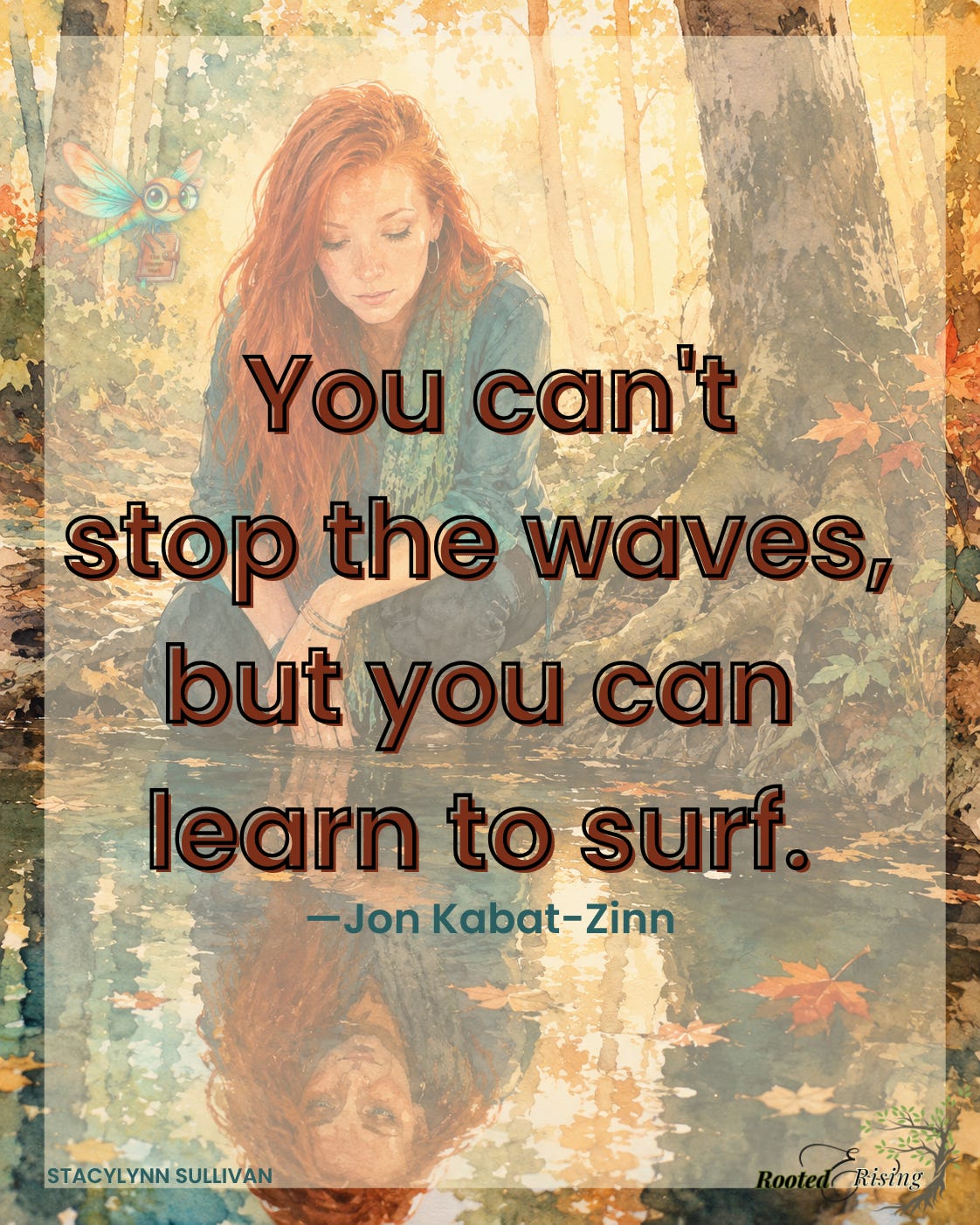
“You can’t stop the waves, but you can learn to surf.”
—Jon Kabat-Zinn
Welcome back to The Master Work!🌳 Thanks for sharing a little of your Sunday with me.
Every business ever built runs on two blueprints at once. One is the one you can point to—the offer, the pricing, the systems, the plan. The other is much more subtle, and it’s made of everything you haven’t necessarily looked at yet: what you believe about worth, what you’re afraid of losing, what you’re still trying to prove, and to whom.
This week’s The Master Work issue is about that second blueprint—the one that quietly determines how well the first one actually works.
I’ve been sitting with a version of this question for a while now: how much of what I call “the business” is really strategy, and how much of it is my nervous system, my ego, and/or an old story making decisions I’ve mistaken for sound ones?
The experience of recognizing one such pattern across my life arrived through a conversation with a loved one this week, suddenly highlighted for me in neon colors, in a situation that had nothing to do with SPS or Rooted & Rising at all—which is usually how you know a pattern is real, and not just a business problem wearing a philosophical costume.
In real time, I was watching myself do the thing I always do, and finally catching it while it was actually happening, instead of noticing it some time later the way I usually do. And I also saw in it the bleedthrough to how I can sometimes operate in my business, as well, as a result.
It got me thinking how our inner life and our outer experiences cross over so much more than we realize in our day-to-day living and building.
So that’s what we’re doing here: looking at the human underneath the founder, and what it actually takes to tell the difference between what the business needs and what something older in you is asking for instead.
And the question we’re asking this week is this…
What is actually happening inside me—and how is it shaping the business I am building?
🌱 The Seed
A mission-driven business is never built from strategy alone. It’s also built from the founder’s beliefs, fears, values, emotional patterns, ambitions, blind spots, and unresolved stories.
Self-awareness is what lets you tell the difference between what the business genuinely needs and what your nervous system, ego, or conditioning is demanding in the moment.
Why does this matter for you and your business?
Conscious founders often assume intention is enough protection here—a sort of compartmentalization between worlds.
It isn’t, however, precisely because unconscious patterns arrive wearing the costume of good instincts: a fear of rejection looks like humility, a need for approval appears to be flexibility, and an old story comes across as merely a strong opinion.
You cannot build an ethical, values-aligned company while remaining unaware of the internal forces shaping your choices.
Your intentions may be sincere, but intention alone does not prevent unconscious patterns from entering your marketing, your leadership, pricing, client relationships, or the company culture.
Because the real question was never whether a founder has blind spots.
It’s whether those blind spots get to run the business, or whether you catch them in time to choose deliberately.
📖 The Work
The saying “as above, so below” is fitting here—or the more accurate version that comes from its kissing cousin: “as within, so without.” While the saying is one of those phrases that gets used in mystical, spiritual, self-help, and philosophical references, its most appropriate context for our conversation is its psychological one.
First, a little back story.
The saying, “as above, so below” comes from Hermetic tradition, and the idea is that patterns at one level of reality may reflect at another.
The phrase is modern shorthand for a line on the Emerald Tablet—a short text of the Hermetic/alchemical traditions that first appeared in Arabic sources from roughly the late eighth or ninth century.
So it’s been around awhile.
The early text has been twisted and molded and recombined, as tends to happen as language and wisdom evolves and moves through time. The original Arabic version, however, actually mirrors the phenomenon I want to talk about today… The thing I want you to notice both in your business and in yourself:
“What is above is from what is below, and what is below is from above.”
This version emphasizes the presentation I am using, which is reciprocal generation.
In other words, what happens inside us affects—and is often reflected in—what happens outside of us, and vice versa. So, rather than different areas of our lives being separate or compartmentalized, as we often portray to ourselves, everything is connected and relational.
And the version I lean into, “as within, so without,” is an apt reminder that what we’re experiencing internally can influence what you create externally.
Which is how we arrive at this week’s The Master Work issue.
You see, I would argue that those two things—your inner world and your outer life—have always been inextricably linked. Which is to say, patterns echo across levels of a system—in a society, in a business, in a body, in the experience of a human being—and examining one seemingly unrelated level can help you garner understanding of another.
This is the territory of Self Awareness.
And the phrase above does a particular kind of ask of your attention… When you notice a pattern somewhere, it behooves you to look for where else that same pattern might be expressing itself.
Sometimes what looks like five separate problems or challenges is one pattern wearing five different coats, holding the same umbrella.
If the metaphysics is a bit much for your sensibilities, taken as heuristic, you can think of it this way: “What recurring structure am I seeing across scales?”
We are not isolated observers of reality, but rather participants in nested systems—biologic, social, ecological, and symbolic.
In the arena of self-awareness, “as within, so without” can help you turn attention towards how inner habits and behaviors can shape what we then notice externally, what we communicate, and what we create or build.

Okay, back to what’s actually happening inside a conscious founder—and how it is shaping the business being built.
So, what is self awareness?
To start with, let’s acknowledge that it isn’t just one thing.
Self-awareness is actually a cluster of capabilities that sit at the intersection of our psychology and philosophical alignment, neuroscience, ethics, and the social aspect of our experience.
This cluster can develop unevenly—across areas like identifying what you feel, noticing your thoughts and beliefs, seeing what motivates you-and how, recognizing patterns that repeat in your behavior, having some awareness of how other people perceive you, and honesty about the story you center your life around. Often several layers are operating at the same time.
The optimal operation of self-awareness isn’t in constant or relentless self-monitoring, though.
It’s actually more about creating more connection with your reality and giving you more choices in your response to your experience of it.
Healthy self-awareness pulls information from two sources before evaluating an experience.
First, from the first-person perspective: what you actually experience—feelings, memories, bodily signals, thoughts, intentions.
Second, a third-person perspective gives the evaluation depth and nuance that no one person can have living inside their own internal bubble. So this includes taking into account the results from repeated actions, what others you trust observe, and what patterns appear across multiple situations.
Together these two perspectives offer a much more complete picture of your reality.
Awareness precedes intentional change.
You cannot change a founder pattern you cannot see.
Before changing your pricing, strategy, schedule, your offer, or team, you need to understand what is driving the current behavior. A surface-level business problem may have a practical cause, an emotional cause, or both.
Self-awareness helps you address the correct problem.
You are not every thought you think.
A thought such as No one will pay for this, I am behind, or I need to act now is not automatically a fact.
Founders make expensive decisions when temporary thoughts are treated as objective business intelligence. I know in my entrepreneurial journey, I have succumbed to this trap on more than one occasion.
You can acknowledge a thought without building a strategy around it.
Naming your inner experience gives you more choice.
The more precisely you can identify what you are experiencing, the less likely you are to act it out unconsciously.
“I feel bad about this launch” gives you little useful information.
“I feel disappointed by the result, embarrassed about being visible, and afraid the market response reflects my worth” gives you something real to examine.
Precision of language creates room for discernment.
I have spent most of my life believing my need to help whenever I can is one of my best qualities. This year, however, inside a situation with a family member, that same instinct cost me something real, that I finally noticed in real time: my health, my bandwidth, my peace.
This month, I had to sit with an uncomfortable question out of that noticing—what happens when the thing you’d call a strength is actually running the show without your permission?
Honesty must not become self-attack.
Self-awareness is not an invitation to judge yourself more efficiently—or harshly.
You are trying to observe your patterns clearly enough to work with them—not gather evidence against yourself.
A conscious founder needs the capacity to say:
This pattern is affecting my leadership, and I can address it without treating myself as defective.
Accountability and compassion are not opposites. You need both.
When I named the pattern I saw that had actually been repeating across decades, rather than castigating myself for missing the signs and attributing obvious consequences in places they didn’t belong,
I had to take responsibility for the behavior that fed the pattern, yes.
But the more useful response was to take this “new” information, and make better, more conscious choices from it. And I have already begun to.
Your business may amplify what already exists within you.
Entrepreneurship places pressure on identity, security, visibility, control, belonging, and self-worth. It often magnifies patterns that are easier to avoid in less exposed environments.
The business did not necessarily create the pattern. It may simply be revealing it.
That revelation can become useful information rather than a verdict.
Without self-awareness, founders often:
Build offers around what earns approval rather than what creates meaningful value.
Say yes to misaligned clients because scarcity feels louder than discernment.
Confuse visibility discomfort with strategic misalignment.
Interpret slow growth as personal failure.
Overwork to feel safe, worthy, or legitimate.
Avoid selling because they associate persuasion with manipulation.
Use “mission” to justify poor boundaries or unsustainable generosity.
Become emotionally reactive to metrics, criticism, silence, or comparison.
Create a company culture shaped by their unexamined habits.
The goal is not to remove emotion from business. I would never advocate for that, as one of my core beliefs is that all business is people business. As such, emotion will always be part of the equation.
Rather, the goal is to stop emotion from operating the business without your knowledge.
😊 Happiness Habit of the Week
This week’s habit:
The next time a decision feels urgent—an email that needs answering immediately, a yes that wants to leave your mouth before you’ve thought it through, a change you’re suddenly sure has to happen today—stop for one question before you act:
Is this what the business actually needs, or is this what my nervous system, my ego, or an old story is demanding right now?
One honest beat is usually enough to tell the difference.
The feeling is real either way. It matters. It just doesn’t get to make the decision alone.
Ask the question. Then choose.
This counts as self-awareness.
Even when the answer is both.
🎨 The Mosaic
The Mosaic is a collection of sources relating to the issue’s topic, that you can add to your menagerie, and widen your life, if you choose. This is the living proof in the outer experience of the premise on the inner life of the human underneath the founder.
I didn’t go looking for these five things specifically this week—they were already here, waiting for me to notice the thread running through all of them. As I was diving into the material for the issue, they came rising to the surface, one by one.
A book about naming exactly what you’re feeling instead of reaching for the nearest word. A film about a man so fixated on his purpose that he nearly misses being alive. A poem about the mirror that compels seeing something in yourself you normally don’t see while you’re busy moving through the world. A song that’s been telling the truth since 1988. And an article that gave language to something I’d been exploring my way through without a name for it.
Here’s the thread through this week’s discoveries—and why each one earned its place this week.
The Five Sources:
📚 Atlas of the Heart—Brené Brown
Brown spends the entire book insisting on precision of language (one of my ambitions, as well)—the difference and nuance between disappointment and regret, between shame and guilt, between belonging and fitting in.
That precision is what self-awareness actually runs on: you can’t tell what the business truly needs apart from what fear, ego, or conditioning is demanding if you can’t first tell the difference between what you’re actually feeling and what you’re calling it out of habit.
I am currently working my through this book, and one of my biggest realizations is how my language for my own experience has shrunk over the years—call it rote inhabiting or a very well worn path. Either way, adding nuance back into the words I use to describe my own internal experience has already helped me do the same on the outside one, too.
Joe Gardner spends the entire film chasing his “spark,” certain that finding his purpose will finally make his life feel like it counts. The film’s real twist is that he was never missing a purpose—he was missing his own life, the one already happening while he was busy chasing the next thing to prove himself with.
Same trap, different coat.
📜Moments of Vision—Thomas Hardy
Hardy’s mirror doesn’t show you the version of yourself you’d choose. It “throws our mind back on us, and our heart,” catching a person unaware, in the tints they’d never notice while performing for the world.
That’s the harder half of self-awareness: not the self you present on purpose, but the one that shows up in the unguarded hours when there’s no audience left to build for.
🎵 Man in the Mirror—Michael Jackson
“If you wanna make a change, take a look at yourself and then make a change.” The most direct line in the whole Mosaic, and maybe the truest: before you can change anything the business is doing, you have to actually look at what’s running the show inside you first.
📰 The Psychology of Founders 2026 Edition—Founders Daily
This piece names something called “identity fusion”—when a founder’s sense of worth gets welded to the business’s performance. Its antidote, “detachment competency,” is self-awareness by another name.
What would you include in this list? Leave me a comment, and I’ll check out your source.
🌿 What’s Taking Root
This week, I’ve been sitting with a line I wrote to myself in the middle of untangling all this: this is what is happening inside me. It matters, but it does not get to make the decision of how it affects me alone. The instinct to help isn’t going anywhere, and I’m not sure I’d want it to.
What’s changing is deploying the first step of actually taking a beat to listen long enough to hear what is behind the behavior, and the pause before I act on it—one question, asked in real time, instead of three weeks later.
I don’t think the two blueprints ever fully separate—the one on paper and the one built from everything I keep examining. How often I stop to ask, in the moment, is what determines which one is actually driving.
🧭 Constellation Compass
🌅 Elsewhere in the Sitting Pretty Strategies constellation recently:
🔮 Inbox Alchemy is the lab side of SPS—where ideas like these get turned into practice through a sequential, evergreen email experience—the hands-on companion to everything SPS publishes, one issue at a time. If you’re ready to move from insight to implementation, [Join us in the lab →]
🗺️ In this issue of Elegant Email Ecosystems, I made the case for framework thinking: why expertise without a container survives the moment it’s delivered and disappears the moment someone tries to pass it on, and how a signature framework turns scattered depth into something a client can actually carry forward. [Read E3 #030 →]
📡 In this issue of The Event Horizon—I made the case that tacit knowledge—the judgment built by actually doing the work, not just codified answers—is exactly what AI can’t replicate, and that protecting the entry-level work that still forms someone’s judgment matters as much as protecting what’s obviously irreplaceable. [Read TEH #004 ->]
📬 Write Back
Where has a strength of yours quietly been running the show instead of just being a strength?
Join the conversation—I’d love to hear what you noticed, and when you noticed it.
One honest line is enough. I read every reply.
If this issue resonated with you, I have three small asks:
① Hit the ❤️—It takes one second and tells Substack this conversation is worth having.
② Hit the 🔄 restack—It puts this in front of your followers—the ones who are already building differently and don’t yet know there’s a name for what they’re doing.
③ Share this issue with a founder you know who could benefit, and might even think you’re their hero. 🦸
💡The right idea finds the right person at the right time. You might be the one who gets it there.
✨ Here’s to the strengths worth examining, so they can stay strengths.
Root before you reach,
~StacyLynn
Founder, Sitting Pretty Strategies
Root Deeply. 🌳 Rise Differently.
P.S.
And if you know a founder who’s been treating a blind spot like a strategy problem instead of a personal one, send this their way.
Sometimes the mirror finds us through someone else’s hands entirely. 💌